August 20, 2026
✅ Rest feels uncomfortable for reasons that go far deeper than “bad habits”.
✅ Achievement, adrenaline, identity, and familiarity are keeping you in motion.
✅ You do not need to go from 100 to zero overnight.
✅ The 347-step self-care ritual is not realistic for someone with your schedule. Let me show you what is.
Hi {{first_name}},
Aren’t you tired of hearing people tell you to:
“Slow down.”
“Put yourself first.”
“Prioritise self-care.”
Meanwhile, your brain is screaming:
“CAN’T YOU SEE HOW MUCH I HAVE TO DO?!”
If so… welcome. 😂
You are very much not alone.
I recently spoke to so many ambitious women who echo this same sentiment.
That rest feels like another chore they’re failing at.
That no matter how hard they keep on pushing, there’s always more to do, and it never feels like enough… let alone that they’re “done”.
That the sheer idea of spaciousness is scary, and they resist it like the plague.
If any of that sounds familiar, this week’s newsletter is for you.
This week, I’m going to show you the 5 reasons why slowing down is so difficult for high-achievers (and, more importantly, what you can do about it).
Not by forcing yourself into another thirty-five-step self-care routine.
Not by adding “REST!!!” to an already overloaded calendar.
But by understanding what is actually happening underneath the behaviour.
Why You Keep Pushing Even When You’re Exhausted
Before I say another word, let me make something clear: I struggle with this too.
Just because I’m the “productivity & planning queen” doesn’t mean I don’t have my own caca to work through.
Quite the opposite.
Some of the things I teach are precisely the things I have had to practise most deliberately myself.
So rather than turning this into another lecture about what you “should” be doing, let’s get curious.
Here are five reasons slowing down feels so bloody difficult:
Reason #1: you LOVE ticking boxes & finishing things.
Where my finisher-completers at????
Half-written email?
Open loop?
Project sitting at 87%?
Absolute torture.
There is something deeply satisfying about crossing the line from unfinished to done. ✅
So when your brain can still see ten unresolved things in front of you, rest does not necessarily feel “restful”.
It can look like sitting on the couch while ten little voices whisper: “But what about me?”
No wonder you want to power through until you can finally exhale…
The catch?
There will always be another box.
Which means if rest can only happen once everything is finished…
rest may never happen at all.
Reason #2: busyness is exciting
You know that tiny surge of electricity that runs through your body when you’re driving to an appointment that starts at 9:30, and your ETA is 9:29?
Or when you’ve had three weeks to complete a project but suddenly become an efficiency Olympian the night before it is due?
There can be something weirdly exhilarating about urgency.
The pace rises. Your attention sharpens. Everything feels important. And you’re a f*cking superhero when you actually get it done on time.
For some of us, that heightened state becomes incredibly familiar.
That does not mean busyness is automatically bad… There are seasons when life is genuinely full.
The problem begins when urgency becomes the only gear you know how to operate in.
Reason #3: your brain has made it mean that success & achievement = your worth as a human being
This one’s a little bit f-ed up, but it’s true for so many of my clients (and myself included).
Many high-achievers have spent years being rewarded for what they produce.
Good grades.
Awards.
Promotions.
Praise.
More responsibility.
Another gold star.
Over time, it becomes incredibly easy to blur the line between:
“I achieved something valuable.”
and
“Achievement makes me valuable.”
The sheer thought of “Who am I if I’m not achieving?!” is terrifying to look at.
Because doing nothing does not just challenge your schedule.
It challenges the identity you have spent decades building.
Reason #4: hustle = familiar, spaciousness isn’t
Here’s something I know about you: you know how to hustle. You know how to get ‘ish done.
Give you any, and I mean ANY challenge, and you’ll figure it out, no matter what it takes.
That’s amazing. That hustle muscle knows how to flex real good. 💪🏼
But play?
Unstructured time?
Sitting down to read without mentally cataloguing everything else you could be doing?
Different story.
And this is why I think of rest as a skill rather than a reward.
If you have practised pushing for twenty years and practised genuine rest for twenty minutes…
which one do you think is going to feel more natural?
It is the gym-bro-who-skips-leg-day problem. You have trained the hustle muscle beautifully.
The other simply needs practice.
Reason #5: your nervous system is wired for familiarity
When my financial coach & mentor told me “Your nervous system will always prioritise a familiar hell over an unfamiliar heaven.”, why whole world flipped upside down.
Of course… if your nervous system (i.e. the primal operating system that runs your brain & body) is wired for survival…
…and it’s equated the hustle go-go-go paradigm as safe & familiar… it’s going to crave more of the same.
Especially when you’re stressed.
That’s why doing “nothing” feels so uncomfortable.
Your nervous system registers it as something new… a.k.a. a THREAT to your survival.
Going from 100 km/h to zero? You may as well be in the jungle with a sabre-toothed tiger staring you in the eyes.
This is also why I get so annoyed at all the “self-care” advice out there that’s trying to force you into a routine that’s likely going to feel uncomfortable and unnatural… because it’s just too much, too soon.
Start small. Start easy.
Speaking of which…
A Gentler Way Forward
My intention with this week’s newsletter is to give you a glimmer of hope that you don’t need fixing…
You’re just doing your best, with the tools and resources that you have available.
And I know it’s lonely out there. It’s scary to admit that these thoughts run through your mind…
…let alone see how they’re keeping you hostage in the same cycle of work → push → exhaustion → recover → work
My intention is to help you see the patterns underneath the behaviour so you can respond to yourself with a little more curiosity (and a lot less judgement).
I’m going through this myself in real-time, and it’s been such a stark reminder that it doesn’t matter how many credentials you have, or how much experience you’ve got… when it comes to rewiring patterns that have been running the show your entire life (heck – perhaps even lifetimes… if you look at how your ancestors lived!), it’s gonna take something from you.
So, here’s the quick-fire version of what I am practising myself to navigate this:
#1: Accept that there will ALWAYS be more “to do”.
“Done” cannot be the prerequisite for rest.
#2: Stop poo-poo-ing busyness.
A full season is not automatically unhealthy. Chronic, relentless overload is the problem.
#3: Separate your worth from your output
Your achievements are things you have done. They are not the entirety of who you are. You are inherently and unconditionally worthy of love, abundance, and joy.
#4: Build your rest muscle gradually.
Five intentional minutes counts. A slow lunch counts. Sitting in the sun without multitasking counts.
Treat your rest-muscle like you would learning how to walk for the first time. It’s new. It’s unfamiliar territory. Don’t expect to have the “perfect” work-life harmony on Day 1.
#5: Make slowing down gentle, not another performance goal.
You do not need to become brilliant at resting by Tuesday.
Titrate. Baby steps. It all compounds – trust me.
Start Smaller Than You Think
Whoosh.
There you have it… the 5 reasons why slowing down is the hardest thing for a high-achiever, and what to do about it.
And perhaps the most important takeaway is this:
You do not need to wait until you are completely depleted before you are “allowed” to stop.
Start small.
A walk without a podcast.
Dinner without your phone nearby.
A Saturday morning with absolutely nowhere to be.
Notice what comes up.
Notice the voice telling you to get moving again.
I have so much more to say about this, and I will be releasing an episode of Resonance dedicated to it very soon.
If you want to hear it when it drops, make sure you are subscribed:
>>> Listen on Apple
>>> Watch on YouTube
To (slowly) making spaciousness feel safe again,
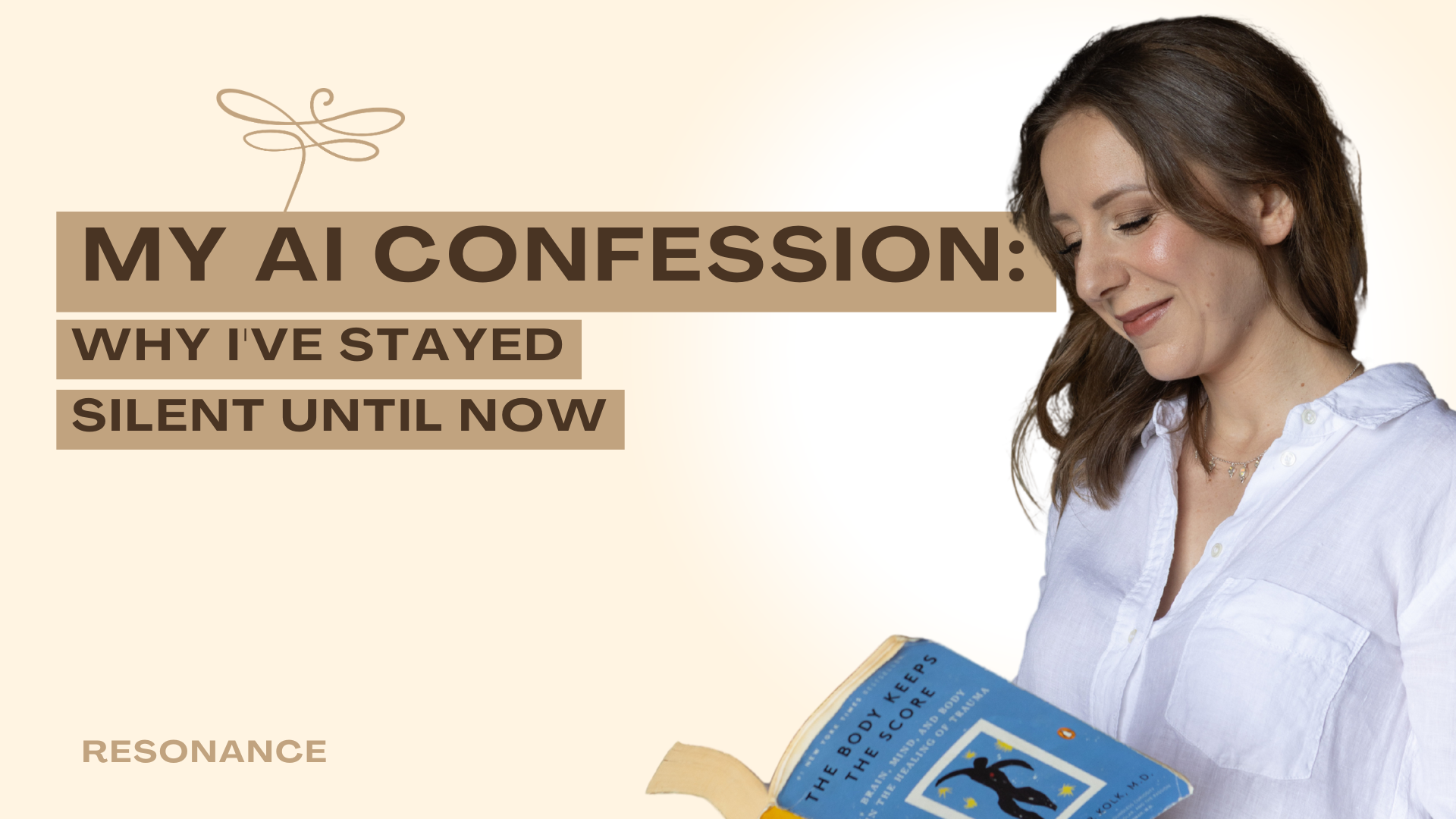
P.S. P.S. Feeling overwhelmed by all the noise around AI, and wondering whether you should embrace it or run in the opposite direction?
In this week’s episode of Resonance, I share why it took me so long to start talking publicly about AI, despite being obsessed with productivity.
We explore both the opportunities and the risks, including how to use these tools intentionally to reclaim time without outsourcing the thinking, creativity, and humanity that make your work… yours.