Resonance – Episode 57
Verbatim Transcript
Speaker: Viktoria Levenberg
There is so much noise in the productivity world. Perfection is an illusion. We like pride ourselves
on how busy we can be, on how overloaded our to-do list is, and how exhausted we are. Do you
really think that you're going to do your best work when you are physically depleted? You do not
need to to be constantly available. I will admit I fell to it for so long. If what you've been doing so
far was gonna work, it probably would have worked by now.
How much more productive would you be if I gave you the key to a secret vault of truth?
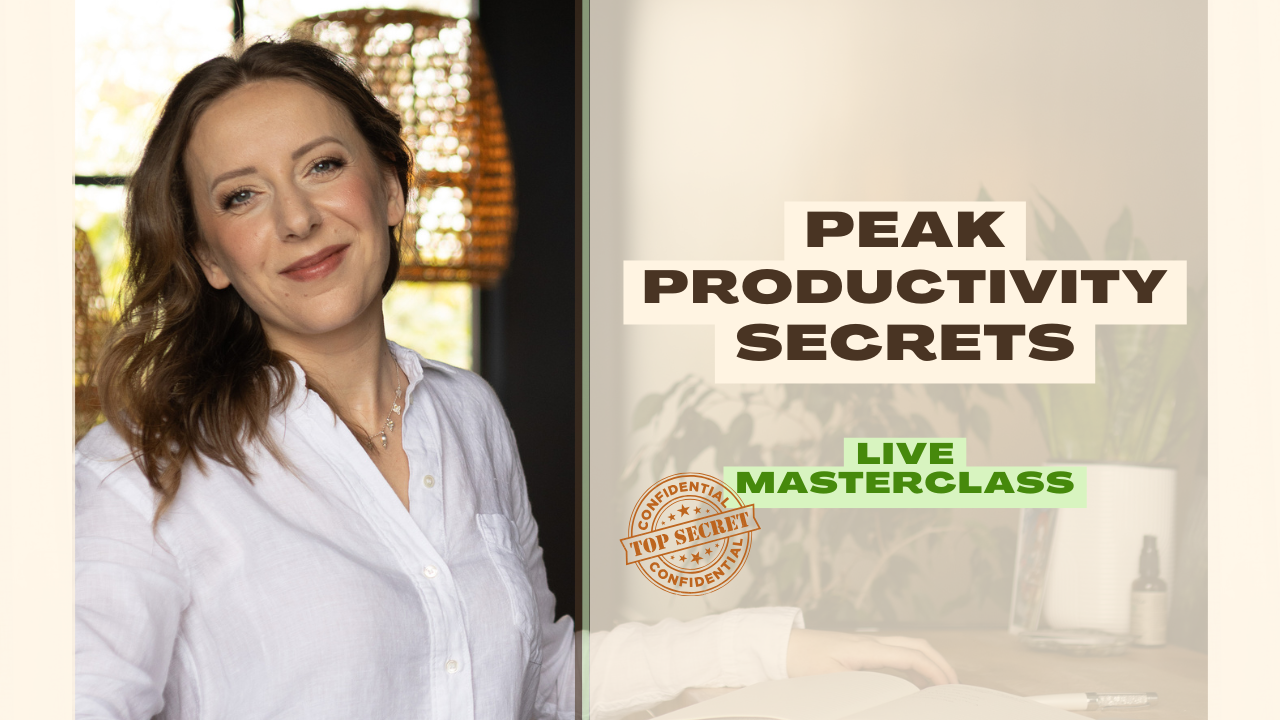
In today's episode, you are going to debunk the 9 productivity myths I wish I knew before I
entered corporate so that you don't have to learn the lesson the hard way. You get to get it from
me in just as little as the super quick episode. So let's dive in.
Welcome to Resonance, the podcast for high performers and entrepreneurs who want to do life,
work, and success differently. I am your host, Viktoria Levenberg, and I'm obsessed with
efficiency, productivity, and planning in a way that harnesses your energy and your natural
rhythms while keeping you in alignment and integrity, because I have figured out that lasting
success is not about the hustle. It is about being in resonance. Let's begin.
There is so much noise in the productivity world, and, you know, I get it. It is basically set up
mostly with the linear productivity model in mind. Um, you know, we've got all of this corporate
culture and societal norms and the...
I have got a slight bit of a twist for you today. Um, and so we'll see how it resonates because, you
know, here on Resonance, it is all about taking what aligns and gently leaving the rest.
And so by the end of this episode, you will have debunked the most common productivity myths
so that you can actually get your work done faster, easier, and more effectively. And these are
lessons that it took me about eight years to learn, and you're getting this in like 30 minutes. So
let's dive in.
Myth number one is perfect equals better results. And I put this right at the top of the list
because I was a sucker for this one. And let me tell you something. Perfection is an illusion.
To be honest, you might not wanna hear this, and this is going quite deep, so I'll only touch on
this lightly, but perfection is in fact a trauma response. Um, all different kinds of procrastination.
It is fear masking itself as perfection. It's those minor details trying to perfect every little bit that
no one's even gonna notice, or maybe even hold you back from starting in the first place.
And it is not true. Like, perfection does not equal better results. Instead, what I have learned in
eight years in the corporate space and over a decade in being a master in productivity, time
management, organisation, all the things, is that clarity comes from aligned action.
Messy is good. It is actually fantastic. And perfection is unfortunately a form of procrastination. It
is masking your fear, and it is also keeping you stuck from reaching your next level of greatness,
exactly where those better results actually sit.
So that's No. 1. Perfection equals better results, debunked. Ha ha. Okay, cool. Um, I don't know if
we're gonna do this with every single one, but we'll see how annoyed you get of me, so ha ha ha.
I'll let my amazing VA who's gonna edit this episode make that decision for you, okay?
So, um, the second myth that we get to debunk is busy equals productive.
Oh my God. Like, this one makes me cringe so bad because we see this everywhere. And this isn't
just in corporate culture. This is in overall societal hustle culture. We like, um, pride ourselves on
how busy we can be, on how overloaded our to-do list is, and how exhausted we are, and how
much, how many meetings we've got overlapping. Oh, I'm triple-booked. It's like this pride of
honour, this pledge of allegiance to the hustle paradigm that is taking you straight to Burnout
Ville.
And so what I have learned in my time is that it's not necessarily about ticking the boxes, even
though it feels so damn good. Oh, as a finisher completer myself, I love taking them boxes, so
don't get me wrong. But it's not about taking them boxes. It is about the quality of boxes that you
take.
And I will be the first one to put my hand up and say that some of my most productive days have
been where no box has been ticked whatsoever.
And what I mean by that is that special, unique creative flow state you get to tap into where you
are making quantum progress that a to do list wouldn't even be able to capture.
And what I'm referring to here is your 5% activities.
So when I speak about your 5% activities, I'm talking about your high-impact strategic tasks,
goals, and think time as well. And so depending on what you do for work, if you run a business, if
you're in corporate, if, you know, you're making strategic decisions around the house and your
family's financial future, this is gonna be really unique and individual to you.
However, there are these things that are really hard to put into a box because they're just so
broad, and they have... they're not linear. Like, this is why they don't fit into the traditional linear
productivity model. They are non-linear in nature.
Like, an example from my life is, uh, something that I'm doing here. You know, like delivering this
podcast to you, um, is an example that falls under that umbrella. But in the entrepreneurship
space, uh, in order to deliver services to amazing people like yourself, um, we've got to work on
things like messaging because there's a difference between being the coach, expert, teacher,
guide, etcetera, and the marketer and the salesperson. And there are two very distinctively
different approaches that need to be taken.
And I personally, even though, you know, I am the efficiency, productivity, and organisation
queen, I could talk about that for days. I'm like, I've got all of those bases covered. When it comes
to things like marketing, that is a muscle that I'm building. You know, that's like somewhere
where I'm a very beginner with the little baby, baby weights, the pound, the two-kilo dumbbells
that, like, almost look embarrassing.
Um, and so it's such a broad topic, right? Like messaging. And there are specific things that I
would do there. And even though it doesn't mean that I, like, ticked lots of boxes, if I just spent
four hours working on my messaging and doing all the things that come underneath that, like,
that is the most impactful, efficient, productive, highest ROI use of my time possible.
So this is an example of where busy does not necessarily equal productive.
Um, I've got another example from you in real life. Again, this is like hot off the press. I went for a
little walk with my partner and our four-legged friend Piper, and she was running around and
chasing the ball. And, um, at the time of the recording of this episode, she will be turning 10
years old very soon. So happy birthday to Piper, cutest puppy in the history of the world.
Um, and we were chatting, and I was, like, chatting to him about my business, and he was telling
me about some of the things going on in his world. And then all of a sudden, he just had this, like,
aha. And he had this massive breakthrough and change in perspective to a topic at work that was
taking up a lot of his time and energy. And it was like this most creative solution that he was like,
"Oh my God, I've been approaching this all wrong." And it solved the situation for him so much so
that when, like, an hour later he was telling me, he, like, told his boss, and, like, his boss was just
like, "This is the greatest thing ever."
I can't believe, and I was like, I was sharing back to Cam, I was like, "I can't believe that." Well, I
can because this is what I teach, but it's just so cool to witness it in real time with people who
aren't doing the work but just absorb it by osmosis, by being in my world, living under the same
roof.
I was like, "It is so cool that you had this download as you were out in the park in the sunshine
with me and Piper. Like, this is literally what I'm saying, is that you would not have had this
realisation from just sitting and staring at a spreadsheet and hoping that, you know, trying to
think your way into this solution."
Um, so myth No. 2, busy equals productive, debunked.
Alright, let's move on to myth number three.
And this one's probably more so for my corporate peeps, um, because it doesn't apply as
significantly in entrepreneurship and kind of personal life, but it can. So I will speak to different
examples just to help you see yourself and your unique circumstances in there.
And this is that constant availability means you are a valuable team member, and you are proving
your worth, and you are amazing.
Oh my God. This is such conditioning.
And I will admit I fell to it for so long. I was the person who would reply to your email before you
even press send to that email. You know, I was, like, always... I prided myself so much on, like, my
quick response time. And I would, you know, I had a boss once that had this habit of, like, his
focus block was 5:00 a.m., and I was like I'll be the first one to reply to all his stuff, and like, even if
I was at the gym, and I'll be like texting with him and call me after work, and all those things. And
then I was like, hang on a second, no, no, no, no, no, no, no. Like, you do not need to be
constantly available.
First of all, boundaries. Like, I'll link up an episode just below. I spoke about it just recently a
couple weeks ago, but I've also actually got another episode that I aired a while back about
boundaries and how they are an energy leak and and a form of self-care, um, if done properly. So
energy leak if done improperly and a form of self-care if done properly, to clarify.
And second of all, it's actually, you're less productive if you're constantly available, because as I've
also spoken on the podcast before, and I'll link up this episode as well, you are more vulnerable
to context switching, which reduces your productivity. It takes you out of flow state. It, um, takes
you longer to get the same thing done than if you just stayed focused and in your zone.
So you've got to protect your time and also, like, be kind to yourself with your time and the
response time.
So, uh, those of you who have ever emailed our customer support team or myself will see that
we've got an out-of-office that says we'll get back to you within 7 business days. This is the same
shared agreement that I put into all of my communities. You know, we've got private community
groups where my amazing students and and members share their incredible wins and questions
and come in for coaching, etcetera. And again, like, my one of our shared agreements is like, I will
get back to you. I will acknowledge your post within 7 business days.
And that is a boundary that I put in place for myself, because otherwise it would be constantly
eating away at me, um, that I haven't, you know, replied to the thing or did the that that, that
that. It's like, no, I do not need to prove my self-worth by being constantly available because no
one expects it of me, um, unless you condition them to.
So again, remember conditioning. You get to set that for yourself, and it's the same thing at home
with your family and your friends and, um, you know, messages. Like, I'm really deliberate with
people when specifically it comes to, you know, messages and calls and all those things. It's I'm
not gonna, unless it's urgent and you're literally like, you locked yourself out and you need me to
open the door for you, you know, or it's something super time sensitive, it's like, I respond when I
have the time and space to respond.
I'm not going to interrupt everything in my life to, because then you're just like walking around
trying to please everybody. And then we come back to boundaries and people pleasing and and
that's a whole separate topic of itself.
So myth No. 3, constant availability means you are a valuable team member or you're proving
your self worth, debunked.
Alright, let's move on to myth number four.
Ah, and I'm not gonna talk too long about this one because I have done lots of episodes on this
specific topic that will be linked up in the show notes below. But the myth that is so so common
and conditioned, and we've been bamboozled into, especially in the corporate world, is that
multitasking makes you more efficient.
That is a lie.
See my earlier point about context switching. You guys gotta protect your headspace.
Multitasking does not work. It's not a thing. It's a waste of time. It is exhausting. And frankly, it's
actually quite disrespectful as well to whatever it is that you should be present to in the moment.
And look, I also fall victim to it sometimes. You know, it's that's the thing with conditioning is we
are all conditioned into it, and so we've just got to slowly consciously uncondition yourself. But it
is not effective. It does not make you more efficient.
So multitasking is more efficient is not true. Myth debunked.
Let's move on to No. 5, which is such a big one, and that is we've been told more hours equals
more work equals better.
And then let me ask you something. Do you really think that you're going to do your best work
when you are physically depleted?
Like, and really, do you? Do you think that just more hours equals you're getting more done?
Because if you still think that, and you've been hanging out in my neck of the woods for quite
some time, then I have not done my job properly, because the way that I approach and teach
productivity is completely different.
It is non-linear. It does not input equals output. It means input has an exponential impact on
output based on being really strategic and curated with how you allocate those specific resources
that again I teach inside my program.
But, you know, like to help you see this a little bit more clearly, um, the more hours that you put
in might actually be things like busy work that is just making you feel good because you are
staying busy and you're doing things, but they're not actually getting you anywhere. Like replying
to emails or haha, clearing out your downloads and cleaning up your desktop. Like, you're
certainly not being more productive. You're doing more, but like, you're not really moving the
needle on what actually matters, right?
And the other thing and and I'm pretty sure I've spoken about this on the podcast as well, there's
like then been studies done from Harvard Business Review and and a lot of different analytics
around people who are exhausted and sleep deprived and, you know, sacrifice their well-being
for the sake of working more hours are delivering work of poor quality.
So you've got the choice of either staying at the office for another 3 hours, looking at the
spreadsheet for the 20 millionth time, having to look at it over and over again because it just all is
mumbo jumbo and mixed up into one thing at this point cause your brain isn't functioning. Or
you can do the hard thing and step away, give yourself the replenishment that you need, knowing
that when you come back refreshed, you are gonna get so much more done so much faster, so
much better.
But it's not about the hours. It's about the quality of hours that you put in and when you put
them in, which again is a whole program. Hahaha. Yeah, like that. It's true. It's I could I could go
on for days about this.
So the myth of more hours equals more work equals better, absolutely debunked. We can get rid
of it.
Let's move on to number six. And oh, I love this one. I I just, um, at the time of the recording of
this episode, I was just teaching on this as well. Um, and I'll do my best to like articulate it in a
way that you can hear, because I'm conscious, you know, this is a podcast. It's not like I've got my
little slides and and things that I can show you.
So bear with me as I try to kind of paint a picture in your mind.
So the myth that we've been told in the productivity space is that output can only be increased
linearly by either putting in more time or more effort. And that's literally, that's like the actual
definition of productivity. I looked it up. I did a bit of research, you know, in in the dictionaries,
and it was like, yeah, either more time or effort.
And then I was like, oh, like, what do they mean by effort? And that just was horrendous and
really sad, because effort basically means hard work, exertion, physical stress. And I was like, well,
that sucks. Like, like, that's not cool. No wonder we're all struggling.
Um, and so this linear formula that thinks that to have more results, right, to have more output,
you've either gotta do more, so put more effort in, or you've got to work longer, so put more time
in, is a lie.
We've been fed a lie, everybody.
It's all fake. Don't tell anyone, okay? Like, this is super secret squirrel. But if you hang out with me
and follow the non-linear formula that I'm about to share with you, you're gonna become
unstoppable. But don't tell them, okay? Because this is your super secret, super secret.
Shh, shh, OK. No one's listening, OK? I can keep going, OK?
Sorry, I'm having some fun with you here, but like, I'm serious. Hahaha.
Productivity is not linear.
Let me and my students be your witnesses, be your proof in the pudding of the fact that it is
exponential.
And if you were to imagine, let's take a moment and go back to your seven-year-old self. Maybe
not seven, maybe it was like 10, when you were in school and you were learning maths. Who
loved maths? Not me.
Anyway, I'm sure whether it's PTSD or very happy memories, you can remember your math class.
And you can probably remember the very first time you saw a graph, and you had the y-axis and
the X-axis, and then there's a little line, right? And there's like a little linear line that we get
taught.
So that is the linear productivity model of output is more time or effort. That's what it assumes.
The more time, the more effort.
Here is the thing.
The non-linear productivity model, if we have your output on the y axis and your time and effort
on the X axis, which, by the way, we're gonna refrain effort as resources because effort signifies
it's hard, versus resources is what you're actually using, whether it's your physical, mental,
emotional, energetic resources, whatever.
This formula is nonlinear, which means it's logarithmic. And I'm sure you've seen, you know, if
you've ever like looked at compounding interest or or all those things, it's like it's sort of it's slow,
slow, slow, and then all of a sudden, boom, it skyrockets.
And that is because of two super-secret scroll things.
One. Not all time is created equal. You can become a time bender, and I will link up an episode
just below this video, where I dove into some of the time management hacks that they definitely
don't teach you at school.
And number two is when you learn how to become a master of your resources and steward them
like the elite star player that you are, that curve exponentially skyrockets. Like, you are limitless.
You have endless potentialities available to you, and it becomes so much more enjoyable.
So this is myth No. 6, this linear formula of output needing more time and effort, debunked.
Okay, how we going? You're doing so good. You're two-thirds of the way there. I know maybe
some of you are like having a couple of mind-blowing emoji moments. You're like, oh my God,
you are changing the way I look at everything. Maybe some of you are like, yeah, Vik, this is so
obvious. Like, this is how I see the world. If so, that's awesome.
Wherever you are is perfect. There is no such thing as behind. Just be here with me. We've got
three more. I've got you, okay?
No. 7.
Hmm, and this one I'm gonna be honest, I'm still working on reframing as well, because it has just
been so, so deeply ingrained and conditioned into me through family, through hmm, society,
through how our world works. And once you understand that this is also a myth, um, and in fact
it's a belief, and it is a belief that is not serving you, and that goes against everything that nature
intended, your life will change.
And that myth is that rest is lazy.
If there is anything that the cycles of success have proven is that rest is an essential part of the
cycle, where actually there is a specific part, whether you are female, male, non binary, whatever,
like, again, this applies to everyone. There is a specific time within your cycles of success where
the most productive thing you can do is nothing.
And I know that in our ha ha producing world, where we are just measured on our how hard we
work, and how much we push, and how much we exhaust ourselves, that that is really, really
hard to fathom. But it's not how we're meant to operate. That is why people burn out, because
they don't honor this really essential phase of the cycle.
That is why people never achieve the most peak amazing, incredible abilities of their potential,
potentialities of the purpose that they came here to this world to fulfill, because they're too
exhausted to even tap into the creative, limitless potential that lives deep down inside them. But
it needs them to be in the fertile void, that little quiet space, for just a moment for it to emerge.
And if any of you have heard, maybe you've heard it on the podcast here, maybe you've heard
me speak about it on the socials or or somewhere else, of the ultradian rhythm, it is basically like
your circadian rhythm equivalent, but it runs 24 hours of every day.
And your body is wired in a cyclical nature, like in so many different ways, but this specific rhythm
that I'm speaking about, this is applicable to all humans. We all have a slightly different way that
it operates, but it literally, your energy peaks and troughs and peaks and troughs. And that
rhythm resets roughly every two hours or so. It's anywhere between 90 to 2, two and a half
hours.
And the magic trick is that when you start to descend and reach the trough, what your body's
actually signal signaling for is some quiet downtime for some rest. But the problem is is that
because we've been so conditioned to just produce and push through the fatigue, that most
people don't honour this through. And so they then exhaust themselves even further.
And even though the ultradian rhythm goes back into the rhythm, it doesn't reset fully in the way
because all of a sudden it's like a, a diminishing economy of scale, you know, it's like a diminishing
return where the next peak isn't quite as high as the peak they had just before that, and it's just
like this downhill spiral.
Whereas when you honour and you work with the cycles of success, you honour things like the
ultradian rhythm, this has been scientifically proven, it is if you honour that little trough, you then
actually get access to more of a peak. And it's sort of this like exponential like the, it's I know it go
it's like it doesn't make any sense. This is why I say like this is so non-linear, but it's like actually
the more you rest, the more productive you become. It's wild. It's a phenomenon. I've seen it in
my life. I've seen it show up for my students. It is beyond anything I could have ever fathomed or
imagined when I first entered corporate.
But here you go. The myth that rest is lazy is completely debunked because it is not true. It in fact
goes against everything that human beings, nature, and the universe are wired to operate into.
Now moving into our eighth myth.
Hmm, and this one might rub my type A high achievers the wrong way a little bit. So I'm gonna
I'm gonna tread carefully here.
But the myth is that willpower and discipline equal success. And I huh, it was when I prided
myself for a long time on, and even now to this day, I like get these comments of you're so
disciplined. Haha.
And I was like, yeah, cool. And I also see a lot of super disciplined people that are stuck in busy
work and keeping their inbox at zero, and they're not productive.
So willpower and discipline are not necessarily directly correlated to success. Of course, you do
require a degree of willpower and discipline to follow through on the plans etc that you set up for
yourself. But it's actually not the main ingredient.
And like especially willpower is a finite resource. You know I, my heart breaks for my initiator
archetypes out there who are waiting to get motivated before they start that next project. Like,
cool, well, I will see you in your next lifetime maybe, because you will probably be waiting forever.
And it's not willpower. It's not discipline. It is not motivation. In fact, what sets the best apart
from the mediocre is the small habits, systems, and structures that keep the momentum going
even when the willpower and discipline isn't necessarily there.
So there you have it. Willpower and discipline do not necessarily equal success. Sometimes it
simply is a matter of having a system that can do the hard work for you.
Now that we've debunked this one, we get to round it out with our last myth. You're doing so
good. I'm cheering you on for still being here.
And that is that productivity habits work for everyone. Productivity hacks are a one-size-fits-all
approach, and what works for me works for you. So let's all go to the same corporate workshop
and follow what Steve blogs told us because it worked for him, so it's definitely gonna work for
every single one of us in the same exact fashion.
Bull bleep.
There's one thing I learned, and this is like what I'm so, so grateful for the health and wellness
and like the health coaching side of my journey for, is that I really got to honour the nature of bio
individuality and how we are truly so, so unique to the fact that one man's food is another man's
poison.
And that works on food, that works on movement, it works on, you know, all different types of
things that you can imagine. And that also applies to productivity.
Productivity is so incredibly personal.
And so something that I really encourage my students to do and build out as we navigate and
work through Efficiency Made Easy together is to make their operating system personal and
unique to them.
So yeah, of course, like my teachings are gonna come with a degree of bias towards what I
personally experienced in my life and and etcetera, but like, I won't be super, I'm honestly really
humble when I'm I'm like, this is just because it worked for me doesn't mean it's gonna work for
you. Like, here's what I know works, and here's what's proven, and now let's massage it and
adapt it in a way that's gonna work for you.
Because you might process information differently. You might be a different personality type. You
might have different needs and requirements. You might have different life circumstances. You
might have different values, different priorities, different goals.
So this is where the real magic comes in, and this is what I love so much about my community
and our and sort of like
Some of the other things that we're doing behind the scenes, you know, after Efficiency Made
Easy, um, is that we really get into the nitty-gritty and just like, hmm, refine it and make it yours
so that your system works for you.
So that is my last and final productivity myth, and it is this illusion that we've been fed that
productivity hacks work for everyone, debunked.
So I'm conscious I've just thrown a lot at you, and you might be a little bit confronted about this
because it's, I like as I advised before getting into it, a lot of this is going against the common 3D
linear patriarchal model of the world. And good, like haha, that's exactly what I'm here to do
because I have tried long enough to fit into the linear productivity system that I then realised was
designed to fail me from the get-go. Like, that is what ignited the spark in me, bringing what I do
and and sharing what I do now with you here today.
Because if what you've been doing so far was gonna work, it probably would have worked by
now.
And so take it from me. Take it from my students who've moved through Efficiency Made Easy or
who are in our current cohort, or take it from the people that I'm sure you see just as much as I
see day to day in my corporate job, grinding and pushing and running around like headless
chicken, still succumbing to these linear productivity lies and myths that we've been fed, just to
be even more exhausted and depleted.
Like, you've got the proof is in the pudding. You know, you've got the choice. You can follow the
ineffective common methods, or you can join my elite crowd and do it differently. Do it more
efficiently, more easily, more calmly, more joyously, cause that's what I'm about. We do things
differently around here, and I wouldn't have it any other way.
And so to summarise this week's episode, The 9 Productivity Myths I wish I knew before I entered
corporate, dispelled for you are:
No. 1: you've got to be perfect to get better results.
No. 2: Staying busy means more productive.
No. 3: Being constantly available means you're a better team member, you're more valuable,
you're proving yourself worth.
No. 4: Multitasking means you're more efficient.
No. 5: More hours means more work means better.
No. 6: Your output or your results are linearly correlated with the time and the effort you put in.
No. 7: Rest is lazy.
No. 8: Willpower and discipline equal success.
And No. 9: productivity hacks work for everyone.
All of these things are myths. They are all incorrect, and I have just given you the proof in the
pudding of why and how and the better way forward.
So my invitation to you this week is to just pick one of these. Pick one and take action.
For example, let's say you're the type of person who really struggles with perfectionism, as I did
once. There was a chapter in my life where that was a real, real issue. Maybe you pick a project
and you declare it complete before it is perfect, despite any imperfections you can still see.
Or maybe you start to play with the idea and dispelling the myth of rest equals lazy, and you
schedule a break in the middle of your workday. Whoo, how naughty does that feel? Like, good.
Green light.
Maybe you are short of inspiration, and you need a little bit of help. And if that is the case, just
shoot me a DM. I would love to have a chat about this. You know, I could nerd out about this for
days.
So there you have it. These are the 9 myths I wish I had dispelled before I entered corporate, and
this took me almost a decade to learn. So hopefully you are not gonna take quite as long to learn
this. You've got this in less than an hour, and I am here to help make this journey even easier for
you.
Hey, if you are curious what it's like to work with me, and you wanna hear more about the
amazing results that my students Inside Efficiency Made Easy have had, just check out the link
below this podcast episode. I would love to get you on the priority waitlist. I would love to have a
chat and just hear what's coming up for you. What are some of your struggles? What are some of
your personal unique circumstances? Because that's what I'm here for.
I'm here to help people, and I just know and stand for the fact that if we can all exhale and
operate at our best in alignment with who we truly are, like, our potential is limitless. Imagine the
world that we are going to create when we all get to operate from this space.
And this isn't like a dig at the corporate world either. This is just a culture that's been created
through, you know, decades and decades of of conditioning. And that is like part of my mission as
well, is to start to infiltrate that space and be like, hey guys, let's wake up everyone. We can do
things differently around here, okay?
And and I might be the trailblazer in this space, and by learning and starting to implement and
play with some of these things, never ever ever underestimate the ripple effect that you're gonna
have on someone else's life.
Like, I have this one friend who, um, recently made some commitments to themselves, and they
shared it with someone else in their workplace, and and they also made a commitment to
themselves around, like, leaving on time and not messaging late. And like, that is so cool, just
seeing that ripple effect and then how that then translates into how much more present you're
gonna be with your family and your loved ones, and how much more life force you're gonna get
to reignite back into like doing things you love for the sake of doing them rather than just getting
stuck and busy.
Like, oh my gosh, the the the potential is endless. So I know I went a little riff raff rant here, but,
um, once you begin to unsubscribe from these myths, you're in for an impeccably amazing
adventure of this lifetime.
So thank you for being here this week. I look forward to seeing you next week, and in the
meantime, have a beautiful rest of your day. Bye for now.
If you're enjoying this episode, you will love my free newsletter, Flourish Weekly. It is an email
that you actually wanna read, and you will be the first to hear about new offerings, events, and
upcoming episodes of Resonance. The link will be in the show notes below, and you can also sign
up through my website, viktorialevenberg.com, or by heading to the link in my bio on Instagram
at Viktoria Levenberg.
The views and opinions expressed by guest on Resonance are their own and do not necessarily
reflect the views of me, Viktoria Levenberg, LVNHealth, or anyone working within the LVNHealth
brand. This space welcomes a diversity of ideas, experiences, and stories, and part of Resonance
is learning to take what aligns and gently leaving the rest.
Also, while I am a National Board-Certified Health and Wellness coach and deeply passionate
about well-being, this podcast is intended for educational and inspirational purposes only.
Resonance does not substitute personalised medical, psychological, or therapeutic advice. Always
seek guidance from qualified professionals for any physical, emotional, or mental health
concerns.